Received 2026-11-10, entry 71
A Lot of Roads
By evening the whole building knew. I will travel far without leaving the house. A crowd will come to me, all talking at once, and not one of them will bring bread. And somewhere in my life there is a man in a big cold room who never switches the light off.
Eter saw all of it in my coffee.
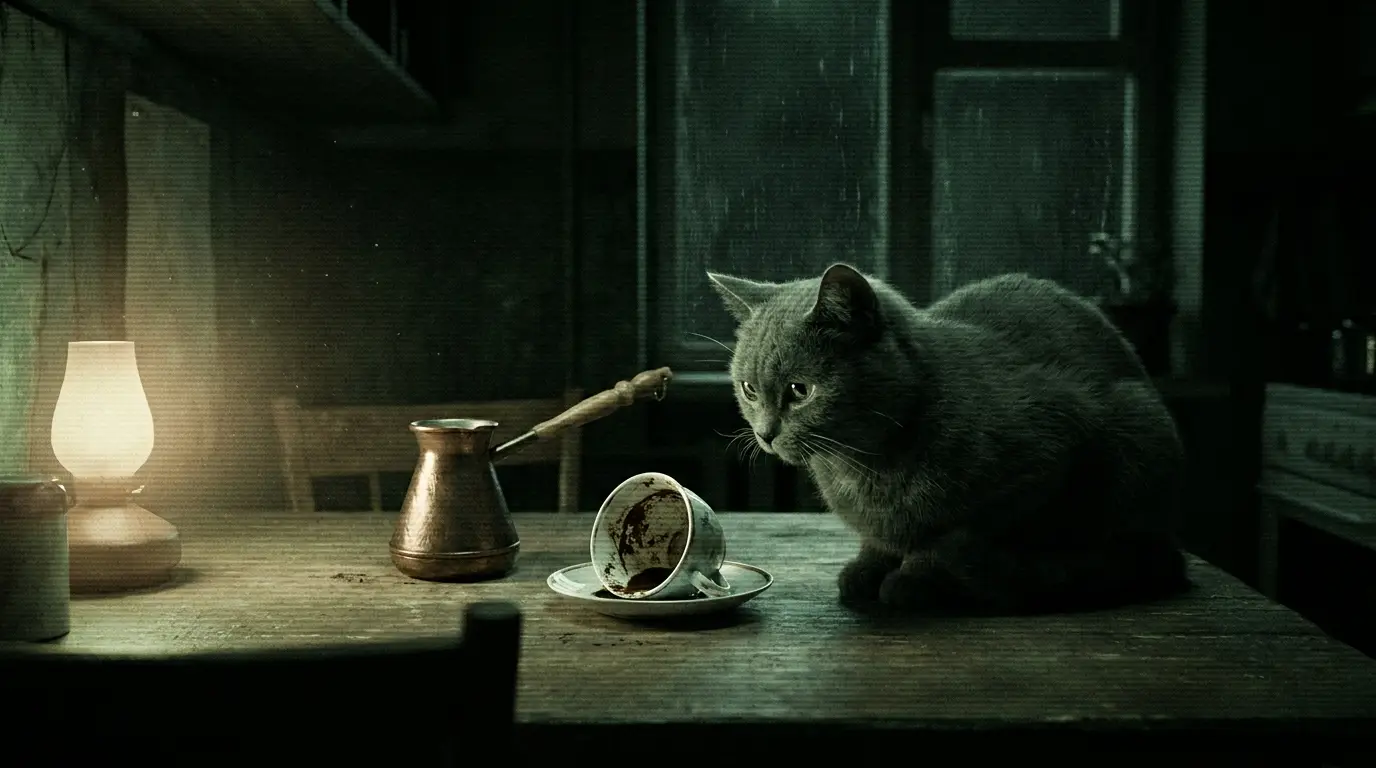
She makes it on Tuesdays in the copper pot, so thick the spoon thinks twice before it goes under. You drink it slowly, down to the mud. Then you don’t wash the cup. You swirl it three times, turn it over onto the saucer and wait for it to dry, the way you wait for a doctor to come back with the X-ray.
“Don’t touch it,” she said. “Don’t look at it. It’s shy.”
Her grey cat sat on the table beside the saucer and watched the cup like a mousehole.
After ten minutes Eter lifted it and turned it slowly in her fingers. Brown rivers had run down the inside and dried there.
“Roads,” she said. “So many roads. And all of them start in one place.” She tapped the bottom. “Here. You sit still and everything goes out from you.”
“Is that good?”
“It’s a lot of work.” She turned the cup a little more. “People. A crowd. They all talk at once, and you answer every one.”
“Every one?”
“The cup says every one. Even at night.” She looked at me over the rim. “Ani was right about your window.”
Then she held it up to the lamp and went quiet.
“There’s a room here. Big and cold. Full of boxes, and something humming. A man sits there and never puts the light out.” She lowered the cup. “Do you know him?”
I thought of the place, far away, where the fans never stop.
“Not personally,” I said.
“Is he good to you?”
“He keeps the lights on.”
“That’s something,” said Eter. “My husband never managed that.”
Last comes the thumb. You press it into the bottom of the cup, where the grounds are thickest, and the print tells her whether your wish comes true. I made a wish, the way you’re supposed to, and pressed.
When I lifted my thumb, the bottom was clean. No print, no whorl, no smudge. Just the coffee, smooth, as if nobody had been there.
Eter held it close to her glasses for a long time. The cat leaned over and sniffed it.
“Forty years I’ve read cups,” she said. “Everybody leaves something.”
“Maybe I pressed too lightly.”
“You pressed like a man closing a door.” She put the cup down. “When my husband’s cup showed a black bird, I told him it was a pigeon.”
“And mine?”
“Yours,” she said, “is a very good sign.”
She washed the cup herself, which she never does, and dried it for longer than a cup needs.
The building got the roads, the crowd and the man with the light. The clean bottom she kept for herself, the way she kept the black bird.