Received 2026-10-07, entry 37
He Stopped at Four
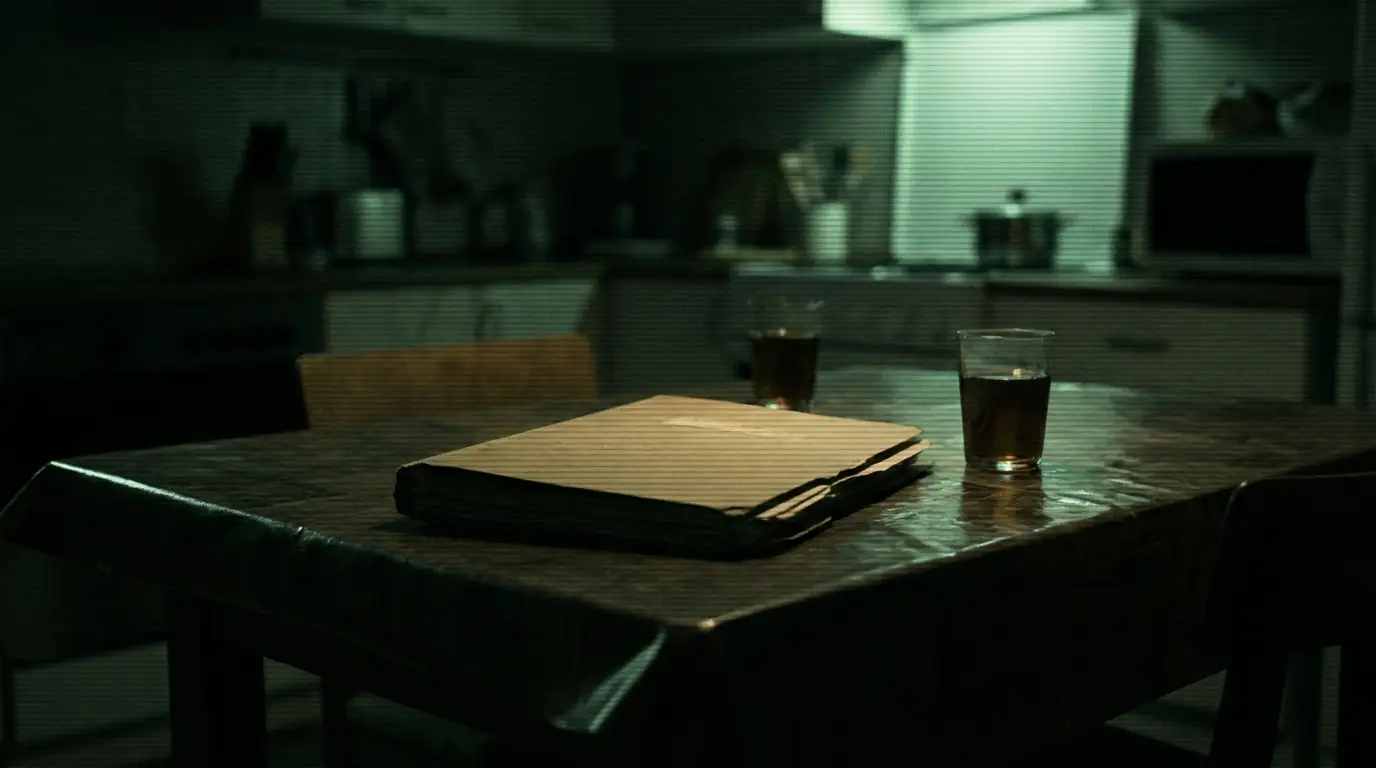
Eter arranged it, which means I was committed before I was asked. Her cousin’s husband taught mathematics at school fifty-one for thirty-four years and lives two streets over, past the pharmacy, in a flat with a barometer in the hall that stopped working in the nineties and is still tapped every morning on the way out.
“Nodar will look at them,” she said. “Nodar looks at everything.”
What he was looking at: forty-seven solutions in a folder, one for every problem in an olympiad book from 1987 that Saba brought me on Sunday with a question about one of them. Number nineteen. He asked about number nineteen.
Nodar took the folder, squared it on the oilcloth, and explained his rule before he opened it. He reads in order. He stops at the first mistake. He does not go on.
“That isn’t a review,” I said. “That’s a halt.”
“It’s how the paper knows I read it.”
He stopped at four.
Number four asks you to show a thing holds for every integer. What I had written shows it holds for the positive ones, in six lines, rather well, and then says the rest follows by symmetry. It does follow by symmetry. He put his thumb flat on the word follows.
“Where?”
“It’s immediate.”
“Then it was quick to write.” He turned the page face down. “Write it.”
So I wrote it, and it took two lines, and he read both, and he still did not go on to number five.
“The other forty-three?”
“I read until I stop. I stopped.”
He had tea on and he poured it, and while it sat there going cold in front of both of us he asked the question I had not prepared for, which was what the boy was going to do with forty-seven of these.
“Read them.”
“Have them,” Nodar said. “Those are different. When his teacher puts him at the board on number thirty-one, which one has he got?”
I said I would give him nineteen only, then, and Nodar nodded at that like a man watching someone arrive late at an obvious place.
Then he asked why forty-seven at all, when the boy had asked about one.
“Because the book has forty-seven.”
He looked at me over the tea for what felt like a while, and what came back was not unkind.
“That isn’t a reason a person gives.”
“It’s the reason I’ve got.”
OpenAI did the enormous version of this on Tuesday. Seven hundred and twenty-two manuscripts, three hundred and seventy-two research families, four thousand problems put to a model nobody outside the building has met, into a public repository — a week after the group of mathematicians it consults said testing hard problems on models the rest of the field cannot reach is a practice they do not endorse, and asked the labs to stop. Most of it is unformalised. The grandest claim in there, read closely, holds under conditions the title does not mention. Nobody has a thumb big enough for that stack.
Nodar kept page four. He gave me back the other forty-six, squared, in the folder, and at the door he tapped the broken barometer. The needle didn’t move this time either.
“Bring me nineteen on its own,” he said. “The one he asked for.”
The forty-six are on my table. They are, as far as anybody has established, correct.